
News detail

Physical AI Deployment Enters a Pivotal First Year: Taixin Semiconductor Bridges the Full-Spectrum Intelligent Link of the Physical World via Edge AI Communication Foundation
When AI steps out of the cloud and into the physical world, why do 90% of devices still "run poorly, connect poorly, and last briefly"? In 2026, global artificial intelligence wil…


When AI moves out of the cloud and into the physical world, why do 90% of devices still"run poorly, connect poorly, and last briefly"?

In 2026, global artificial intelligence will welcome a decisive inflection point — Physical AI and Edge AI officially enter their first year of scaled implementation. According to the latest data from Frost & Sullivan, the global edge AI chip market size exceeded $10 billion in 2024, with a compound annual growth rate (CAGR) exceeding 40%, projected to surge to $32.55 billion by 2030. From embodied robots and AI glasses to outdoor security and smart agriculture, Edge AI is becoming the strongest carrier for AI to reconstruct the real economy with "milliwatt-level power consumption, millisecond-level response, and dollar-level cost".
However, a harsh reality faces the entire industry: no matter how powerful cloud computing power is, it cannot solve the challenges of distance, occlusion, power consumption, and mass production in the physical world. Devices disconnect when moving away from routers, batteries drain in days, multi-chip combinations incur high costs, lab demos cannot be mass-produced... What key foundation is missing for Physical AI to truly penetrate all sectors?
An industrial migration from "Cloud Heavy Industry" to "Edge-Dedicated Computing Power" has officially commenced.

Why Edge AI is a Must-Answer Question for Physical AI
The core proposition of Physical AI is to let AI step out of the cloud and into the real physical world —Embodied robots operating across floors, outdoor AI security monitoring, large-scale deployment of smart agriculture— These scenarios share a common characteristic: they cannot rely on the cloud.

"Industry research points out that pure cloud AI faces four insurmountable bottlenecks"
Privacy is the first wall.When AI begins processing emails, photos, and health data, 'data uploading to the cloud' becomes a trust issue. Edge AI completes inference locally, with inputs and outputs never leaving the device — this sense of security through 'physical isolation' cannot be replaced by any cloud encryption promise.
Latency is the second wall.Studies show that when response time exceeds 700 milliseconds, users noticeably perceive lag; exceeding 1.5 seconds causes frustration to rise exponentially. Cloud inference must undergo a complete chain of "Device → Base Station → Core Network → Data Center → Return", where latency caused by physical distance cannot be eliminated. Edge AI compresses inference into the millisecond level, making real-time translation and real-time visual recognition truly 'real-time'.
Cost is the third wall.If ten billion devices globally call cloud large model APIs ten times daily, the inference cost for cloud vendors would be astronomical. For device manufacturers, rather than paying huge API fees annually, it is better to spend a few extra dollars once on chips to purchase the computing capability outright.
Personalization is the fourth wall.Cloud-based large models are "one-size-fits-all," unable to recall user preferences and habits. Edge AI can continuously learn locally, fine-tuning a model that "understands only you"—an experience the cloud can never offer.
Industry research provides a clear judgment:"The role of edge devices is upgrading from 'dumb terminals' to 'intelligent nodes'—this is a structural change that has never occurred in the past decade."

Convergence of Technology Curves: Why Now?
No matter how strong the demand is, without technological breakthroughs, Edge AI will remain stuck on paper presentations.

“2023–2024, two technology curves experienced a historic convergence.”
First Curve:Models are getting smaller. Llama3.2, Microsoft Phi, Google GeminiNano, Alibaba Qwen2-5B—small and medium-sized models distilled and quantized have already shown stunning performance on specific tasks. Lightweight versions of domestic large models such as DeepSeek, Doubao, and Tongyi Qianwen have emerged densely, turning the deployment of large models on the edge from "science fiction" into an "engineering problem."
Second Curve:Chips are becoming specialized. General-purpose CPUs run AI inference with extremely low efficiency; traditional GPUs consume too much power to fit into devices. Dedicated NPU and LPU architectures have become mainstream, achieving order-of-magnitude breakthroughs in energy efficiency.
The convergence of these two curves is precisely the timing window that Taixin Semiconductor has hit.

Four Major Chips, Precisely Positioned Across All Physical AI Scenarios
Facing industry opportunities, Taixin Semiconductor did not choose "one chip to rule them all," but instead adhered to a full-stack self-research route, using four dedicated chips to precisely cover the four core scenarios of physical AI:
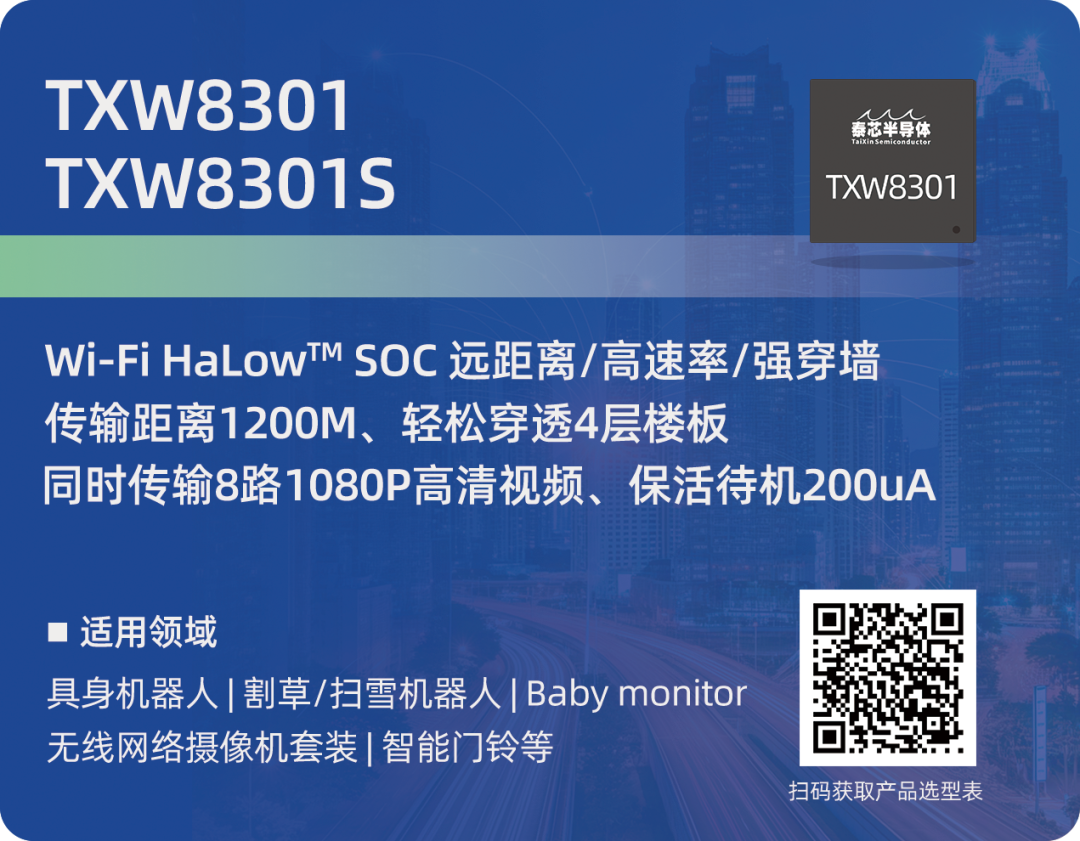
■ Long Range · Select TXW8301
(Wi-Fi HaLow™ SOC)
Physical AI devices need to operate autonomously in the real physical world and cannot be "trapped" by Wi-Fi coverage radius. TXW8301 operates in the Sub-GHz low-frequency band, with an outdoor open transmission distance of up to 1.5 kilometers, capable of penetrating 4 floors or 9 ordinary walls. A single gateway supports 8191 nodes for concurrent access—enabling embodied robots, lawnmowers, and agricultural sensors to truly "operate independently." One chip solves outdoor and wall-penetration scenarios, eliminating the need to piece together multiple suppliers.
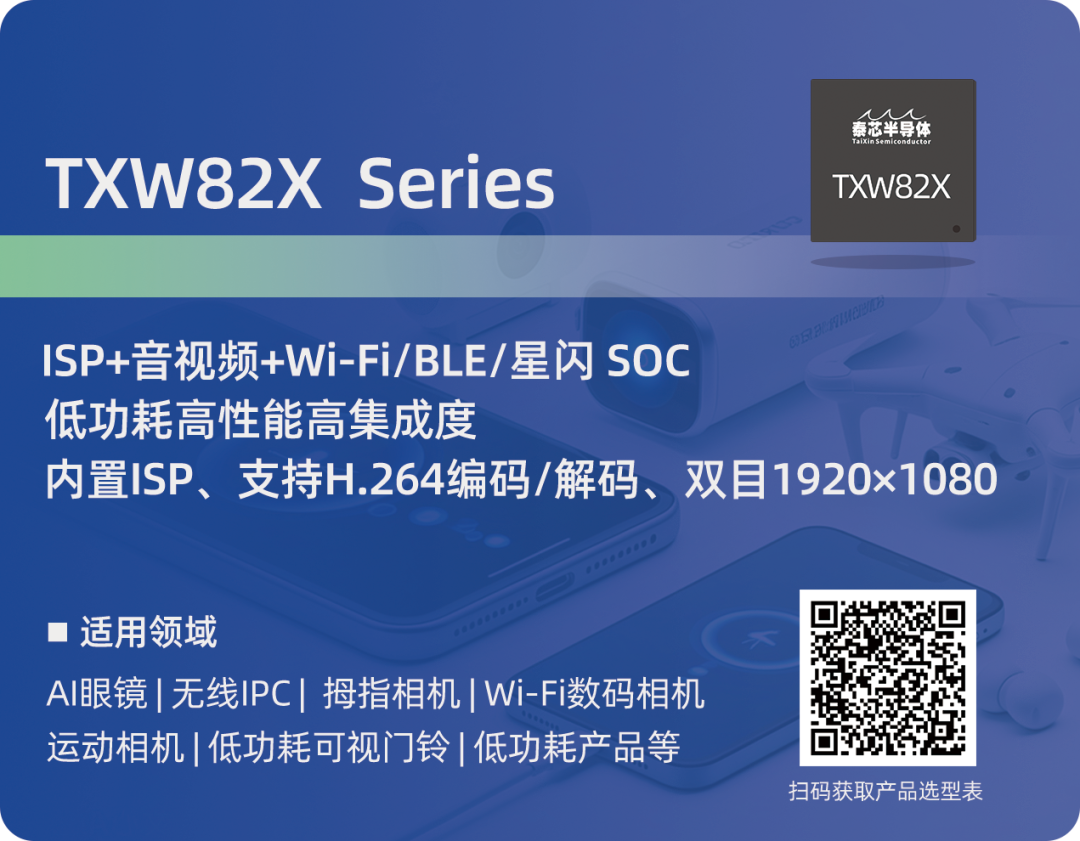
■ Low Latency · Choose TXW82X
(SparkLink Tri-mode Audio/Video SOC)
Latency is the lifeline of Physical AI. TXW82X integrates SparkLink SLE technology, with response times as low as milliseconds. It features a built-in professional ISP supporting dual-eye 1080P and H.264 hardware encoding/decoding. One chip simultaneously supports Wi-Fi + BLE + SparkLink tri-mode capabilities, replacing traditional multi-chip combinations and reducing system BOM costs by over 50% — ensuring AI glasses, wireless IPCs, and action DVs make no compromises on image quality and response speed.
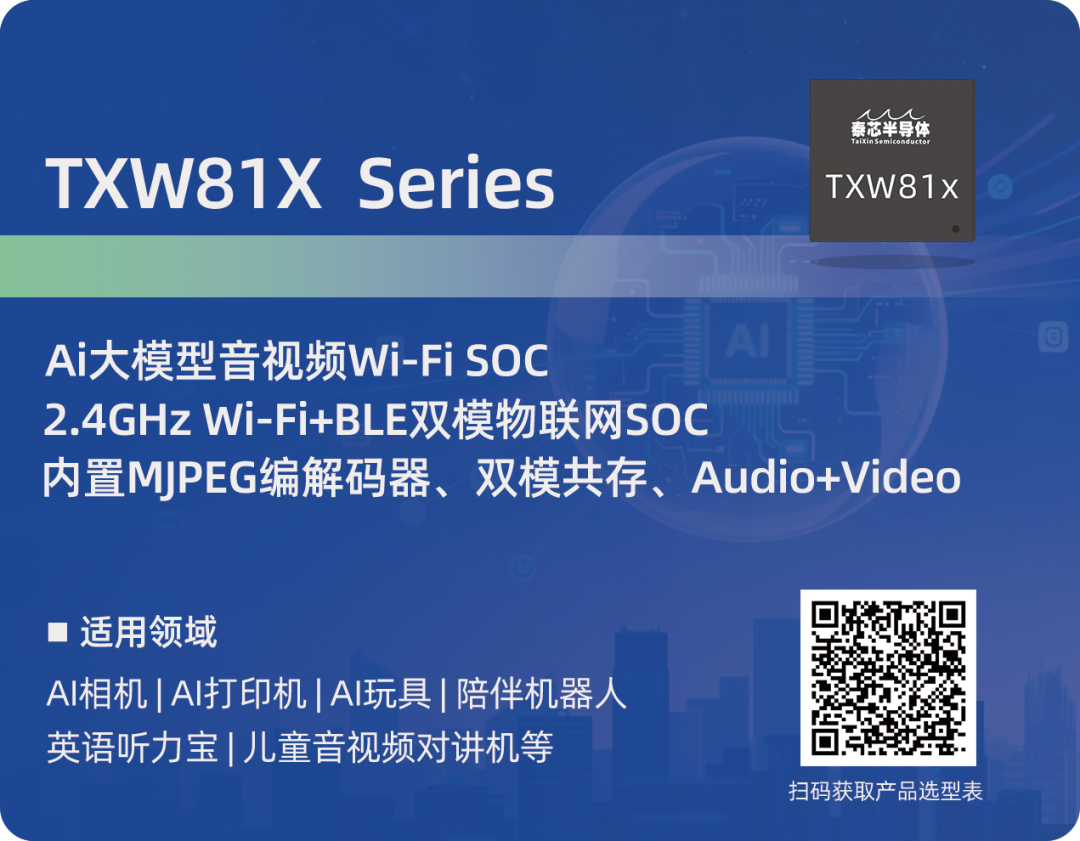
■AI Large Models · Choose TXW81X
(AI Large Model Audio/Video Wi-Fi SOC)
For AI large models to truly serve users, they must ultimately run on devices. TXW81X seamlessly connects with eight major models: DeepSeek, Doubao, Tongyi Qianwen, Baidu, Coze, iFlytek LingSi, Kuqi, and TanGe. Localized deployment ensures data stays on-device, enabling personalized AI interaction while safeguarding privacy — turning AI toys into smart partners that can speak and interact instantly, and allowing companion robots to truly remember your habits.
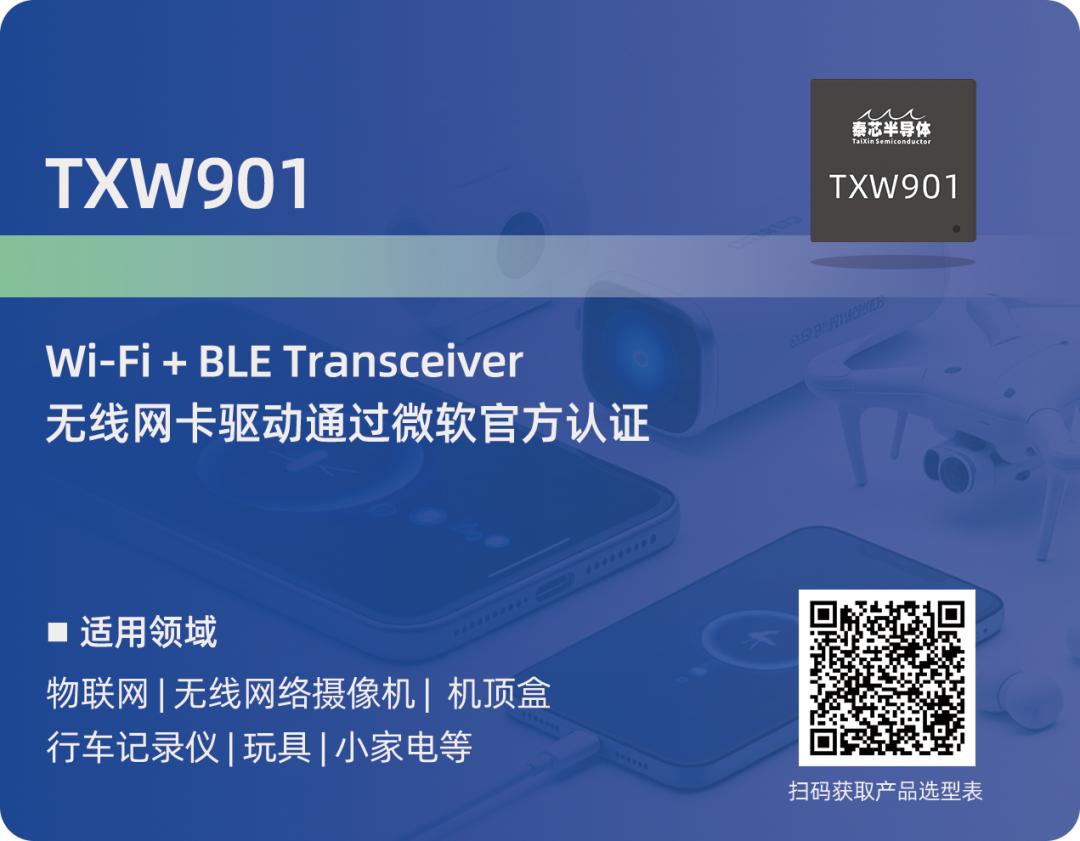
■ Wireless Connection · Choose TXW901
(Wi-Fi/BLE Transceiver)
Massive fragmented IoT devices require a stable wireless connectivity chip certified by Microsoft. TXW901 covers categories such as wireless IPCs, set-top boxes, and dash cams via SDIO/USB dual interfaces. Its drivers are officially certified by Microsoft, allowing solution providers to mass-produce directly upon adoption.

Mass Production Validation: Taixin Chips Empower Physical AI Across Industries
Technology only has value when implemented. Taixin chips have been validated by industry leaders such as Hikvision and Ezviz, and are being deployed in bulk across core Physical AI scenarios:
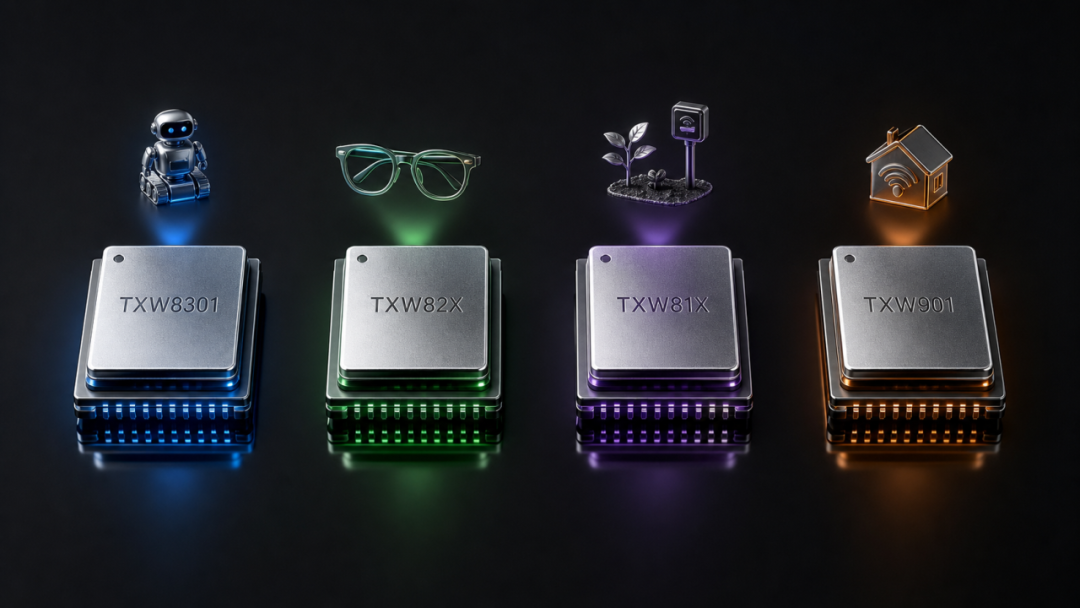
-
Embodied Robots: Equipped with TXW8301, achieving stable long-distance connection up to 1.5 km and strong wall-penetration transmission, solving the problem of mobile device disconnection, with ultra-low power consumption ensuring long-duration continuous operation;
-
Smart Agriculture / Industrial IoT:Adopting TXW81X, supporting large-scale networking and massive node access, enabling stable operation without wired networks or external power supplies in various outdoor and industrial mining scenarios;
-
AI Wearables / Smart Glasses:Selecting the high-integration TXW82X wireless audio/video chip to streamline hardware design and facilitate rapid mass production of AI glasses;
-
Outdoor AI Security:Paired with TXW8301 for long-distance communication, compatible with solar power supply solutions, creating all-weather unattended intelligent security;
-
Smart Home / Consumer Electronics:Relying on TXW901's stable connectivity, empowering AI video door locks, AI toys, and companion robots to achieve smooth intelligent interaction.

The Most Trusted Edge Communication Partner in the Physical AI Era
The edge AI chip landscape is forming an intriguing power map: On one end, smartphone SoC leaders attempt to cover all scenarios with "general-purpose platforms"; on the other, vast fragmented terminal devices require more flexible, customized, and cost-effective solutions. Industry research judgments hit the nail on the head:

"Specialized chips for specific tasks deliver greater impact than broad-scope solutions."
Taixin Semiconductor is the player carving out a niche—adhering to full-stack self-research, focusing on core wireless audio and video fields, covering long-range, low-power, high-integration, and AI large-model scenarios with four dedicated chips. We make no unnecessary promises, only producing chips that can be mass-produced.
In the future, AI architecture will form a layered collaborative system featuring deep thinking in the cloud, regional collaboration at the edge, and instant response at the device level. Taixin Semiconductor will continue to iterate on fully self-developed chip technology, with "AI Intelligent Connection at the Edge, Chips Leading All Things", becoming the most trusted edge communication chip partner in the Physical AI era.

About Taixin Semiconductor
Zhuhai Taixin Semiconductor Co., Ltd. was founded in 2016. It is a National High-Tech Enterprise and a Specialized and New "Little Giant" Enterprise, focusing on AIoT wireless communication and edge AI audio/video chip design. The core team has over 15 years of deep experience in the semiconductor industry, cumulatively designing and selling over 1 billion chips. The company possesses the world's first mass-produced Wi-Fi HaLowTMchip, the world's first mass-produced Wi-Fi + BLE + NearLink tri-mode audio/video SOC. Products cover security, industrial, automotive, consumer electronics, medical, and other fields, providing full-stack chip solutions for the deployment of Physical AI and Edge AI.
*This article contains AI-generated images